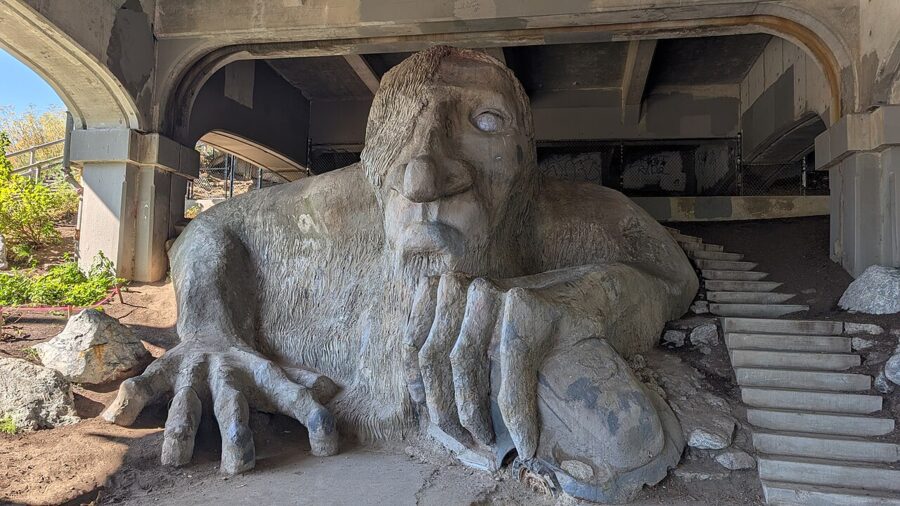
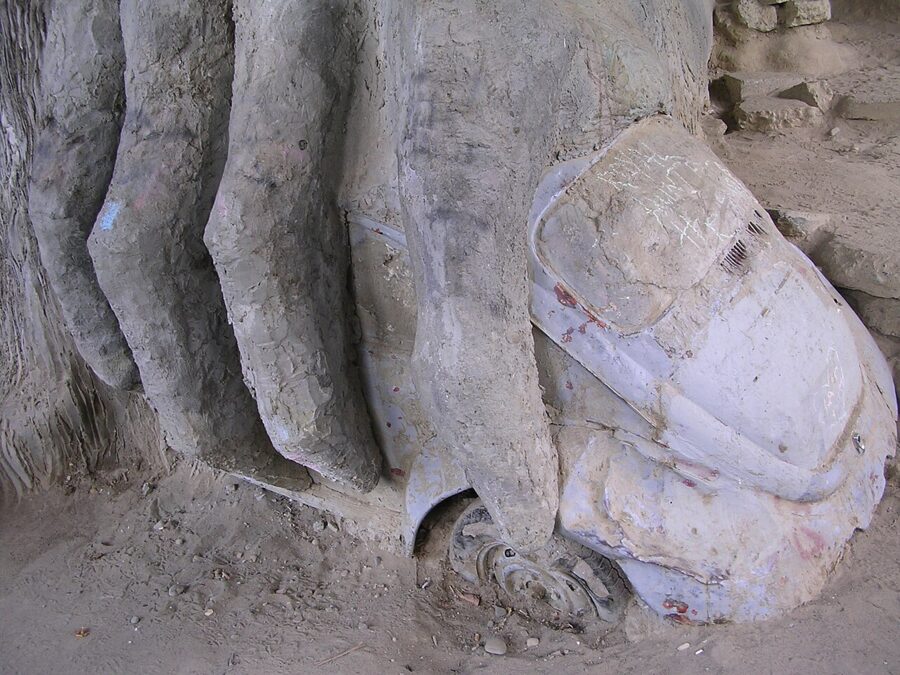
The Fremont Troll lives in the shade. It crouches under the north end of the Aurora Bridge, 18 feet (5.5 m) of gray concrete with a real Volkswagen Beetle pinned under one hand, and the bridge deck above it keeps the sun off its face for most of the day. That makes it one of the few landmarks in Seattle where the hour matters less than the crowd, and the crowd is what you plan around.
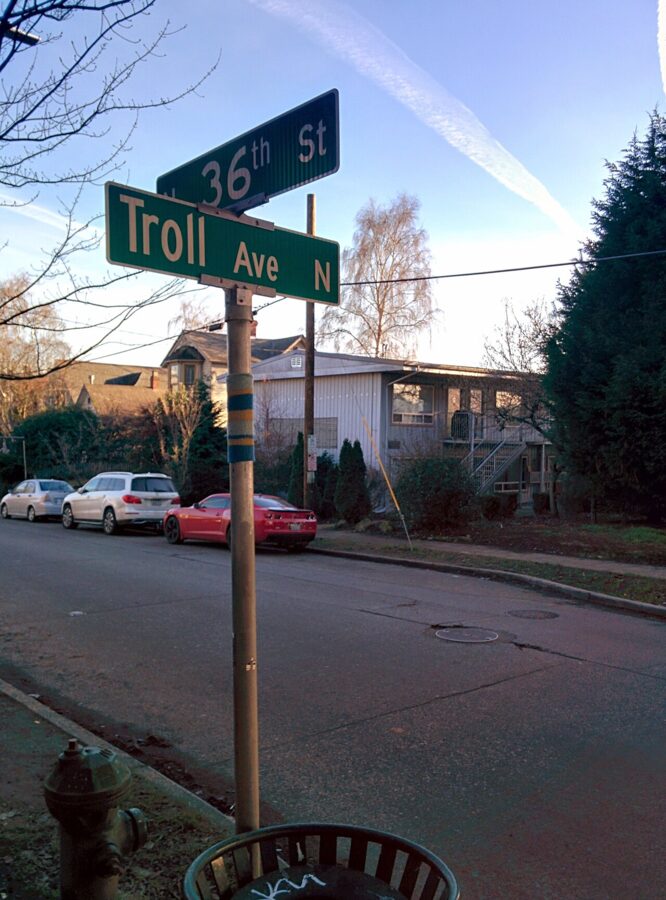
It sits where North 36th Street meets Troll Avenue North in the Fremont neighborhood, about two miles north of the Space Needle. There is no gate, no fee and no closing time, and people climb onto its arm and head all day. Twenty minutes is plenty for the troll itself; then walk downhill into Fremont, which has a 53-foot rocket, a bronze Lenin and a Sunday market within a few blocks.
Contents8 parts
Who made the troll, and why it holds a Beetle
In 1990 the Fremont Arts Council ran a competition for the dead-end space under the bridge, which by then had become a dumping ground. A panel chose finalists and the neighborhood voted at a booth at that year’s Fremont Solstice Festival. The troll was a late addition to the shortlist and still won easily, with about 1,300 ballots cast.
The design came from Steve Badanes, an architecture professor at the University of Washington, with Will Martin and Ross Whitehead, then his students, and Donna Walter. Volunteers helped prepare the site, and a grant from the city’s Neighborhood Matching Fund paid part of the bill. The team built it over a few months in 1990 from steel rebar and wire covered in about two tons of ferro-concrete, with a hubcap for one eye.
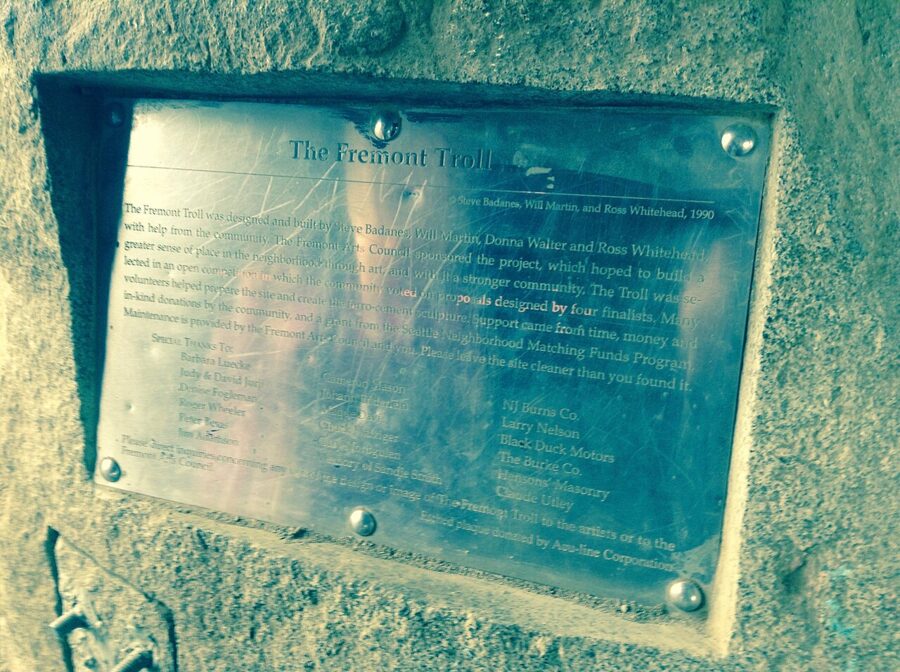
The idea comes straight from the folk tale of the troll who lives under the bridge. The car is the joke with an edge. Badanes has described it as a jab at Seattle’s fast development, and the Beetle originally wore California plates.
The car started life as a time capsule, with a bust of Elvis among the things sealed inside. After someone broke in and took the Elvis, the team filled the Beetle with sand and then concrete. Graffiti and chipped concrete have been a running problem ever since, and the plaque puts maintenance on the Arts Council and on you.
The Arts Council treats Halloween as the troll’s birthday. Trolloween starts at 7 p.m. on October 31 with music and a pageant at the troll, then a costumed procession called the Haunt of Fremont winds through the neighborhood. Check the Fremont Arts Council calendar before you plan around it, since the route moves with the weather.
Getting there and parking
The troll is at North 36th Street and Troll Avenue North, Seattle 98103, under the bridge that carries Highway 99 over the Lake Washington Ship Canal. If you drove in on Highway 99 from downtown, you crossed right over it. From central Fremont it is a short uphill walk east along North 36th Street, about three blocks past the Lenin statue.
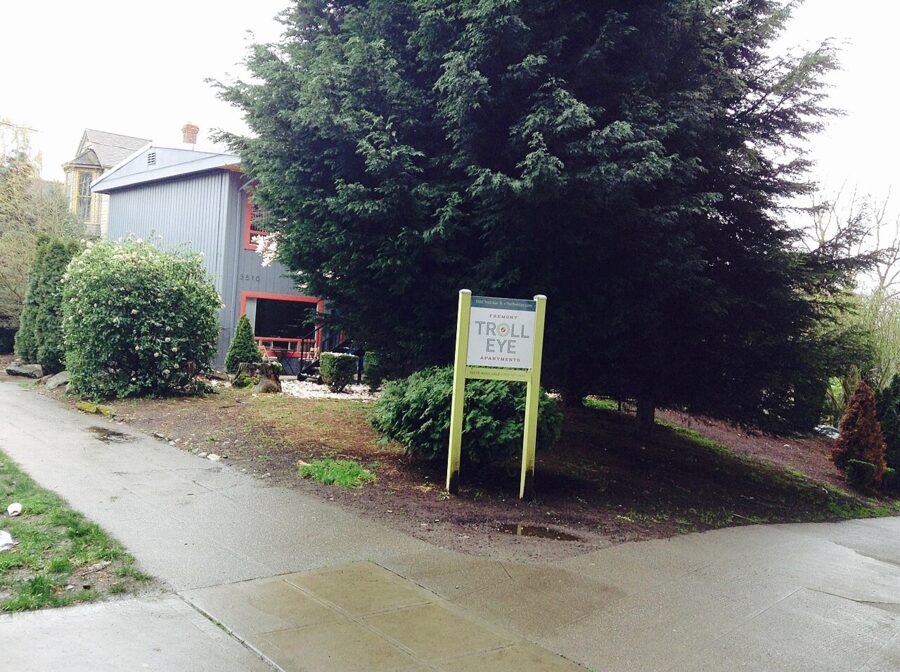
By bus, King County Metro routes 40 and 62 run between downtown and central Fremont. As of March 2026, northbound route 40 stops in front of the Lenin statue on Fremont Place North, and routes 31, 32 and 62 stop on North 35th Street near the library. From either stop the troll is a five-to-ten-minute walk uphill.
There is no parking lot. The blocks right around the troll are residential street parking, so read the signs for time limits. The commercial blocks of Fremont below are a city paid-parking area, Monday through Saturday, at $1.00 an hour in the morning, $5.00 in the afternoon and $6.50 in the evening as of November 2026. Street parking across Seattle is free on Sundays, which is also market day, so expect competition for spaces then.
Access is on foot over uneven ground. The approach is uphill, the troll sits on a sloped concrete base, and the upper viewing spot is reached by stairs. I would not count on a step-free route to the troll’s face.
Photographing the troll
Light
Because the deck shades the troll, its face gets soft, even light through most of the day and on overcast days alike. The background is the problem. Behind and beside the troll the street is in open light, so a bright day gives you a gray subject against a much brighter edge.
Expose for the troll’s face and let the edges go light, or bracket and blend. Seattle’s long gray season flattens that difference and is no reason to stay away.
Angles
The classic frame is from the foot of the slope, a few steps back and a little to your left, so the head, the reaching arm and the Beetle line up with the bridge girders above. A wide lens, around 24mm equivalent, takes in the whole troll from there. Shoot from waist height rather than eye level and the troll looms instead of sitting.
Then climb the stairs on the troll’s left. From partway up you look across at the head instead of up at it, with the underside of the deck filling the top of the frame. For scale, put a person on the arm or beside the hand; without one, the troll can read as a model.
The third picture is the detail: fingers on the crushed Beetle, the hubcap eye, the texture of patched concrete. Walk around the sides too, because the troll’s back half disappears into the slope and the join is part of the story.
Crowds, climbing and using the picture
The troll is on almost every Seattle sightseeing list, so expect a line of people waiting for the head on a summer weekend afternoon. Early morning on a weekday is the quiet window, and I would come before 10 a.m. if you want the troll with nobody on it. Otherwise wait for the gaps; groups tend to pose, shoot and leave within a couple of minutes.
Can you climb on it? Yes, and people do all day, kids included. The concrete is rough when dry and slick when wet, the head is high enough to hurt if you slip, and the hand and Beetle are the easiest places to sit.
One point if you sell photographs. The artists hold the rights to the troll’s image, and the plaque asks that any use of its design or image be cleared with them or the Fremont Arts Council.
The Aurora Bridge overhead
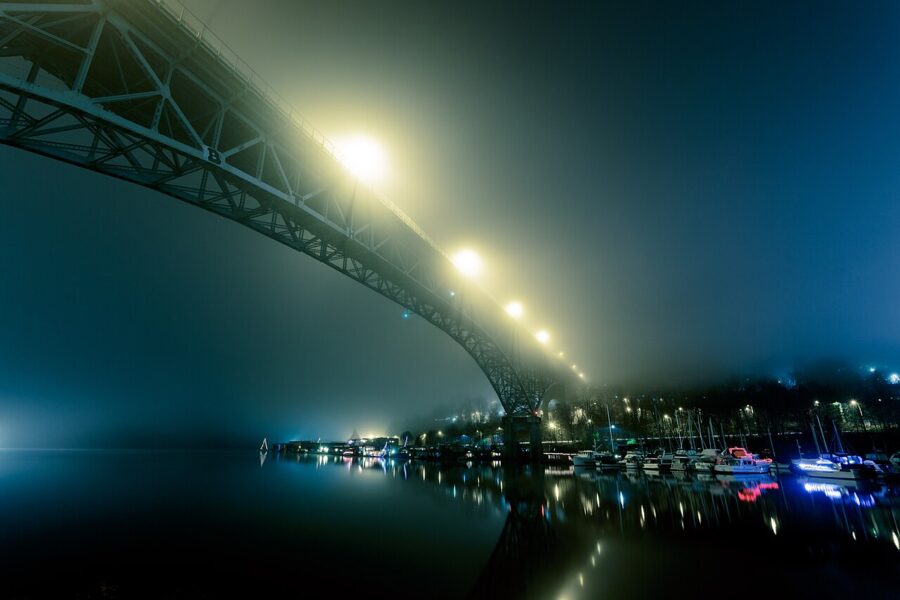
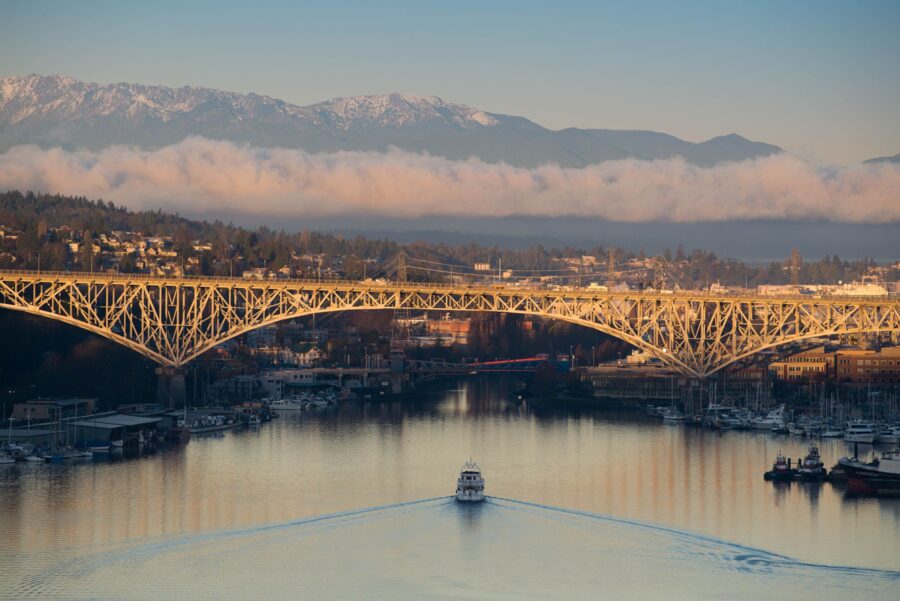
The bridge is officially the George Washington Memorial Bridge, opened on February 22, 1932, the bicentennial of Washington’s birth. It runs 2,945 feet (898 m) and stands 167 feet (51 m) above the water. The Washington State Department of Transportation maintains it as part of Highway 99.
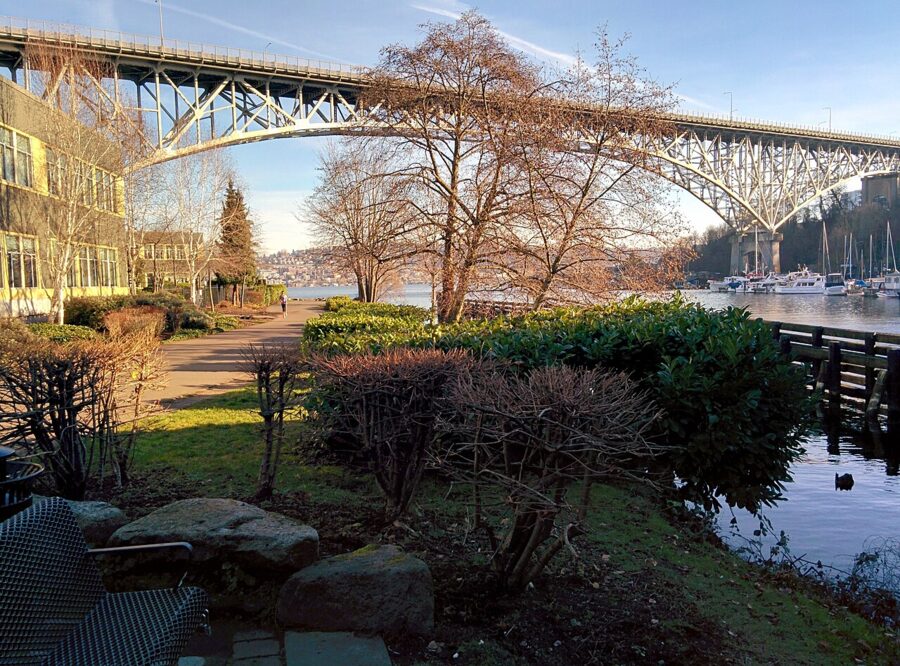
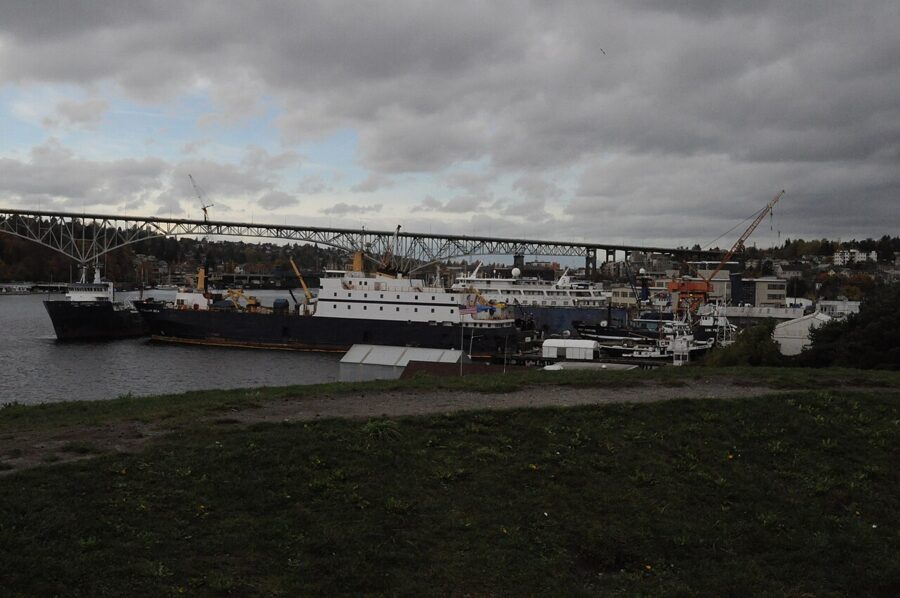
For the bridge itself, go down to the water. The path along the north bank of the canal gives you the full steel arch in profile, and from the hill at Gas Works Park you see it end-on across Lake Union with ships moored below. The bridge runs north to south, so from Gas Works it sits to the west and late afternoon turns the steel into a silhouette; morning is when sun falls on the side facing the lake.
Fremont around the troll
Fremont calls itself the Center of the Universe and has the street furniture to back it up. Everything below is within about half a mile of the troll, mostly downhill.
The Lenin statue
Three blocks west of the troll, on the triangle where North 36th Street meets Fremont Place North and Evanston Avenue North, stands a 16-foot bronze of Vladimir Lenin by the Bulgarian sculptor Emil Venkov. It was made for the town of Poprad in what is now Slovakia, and after communism fell Lewis Carpenter, an English teacher from Issaquah, mortgaged his house to bring it to Washington. It has stood in Fremont since 1995, on private land, and calls to remove it come up regularly.
As of mid-2026 it was still there, on a plaza with food stalls where a tire shop once stood. The Arts Council dresses it for occasions; in June 2026 it wore a soccer jersey for the World Cup until the decorations were stolen. The Arts Council’s next event there is the Fremont Flurry, set for December 5, 2026, at 5 p.m.
The rocket and the guidepost
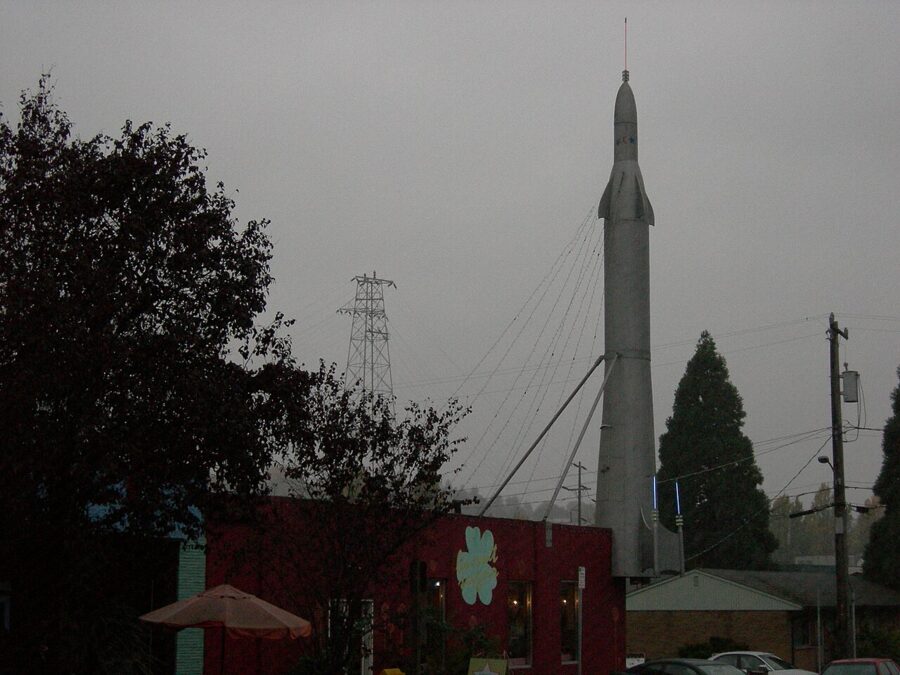
The Fremont Rocket stands upright on the corner of a building at North 35th Street and Evanston Avenue North, 53 feet (16 m) tall and painted with the neighborhood motto, “De Libertas Quirkas”. It is not a real missile but the tail boom of a Fairchild C-119 cargo plane dressed up as one, rescued from a downtown Seattle surplus store that was closing. It has stood here since 1994.
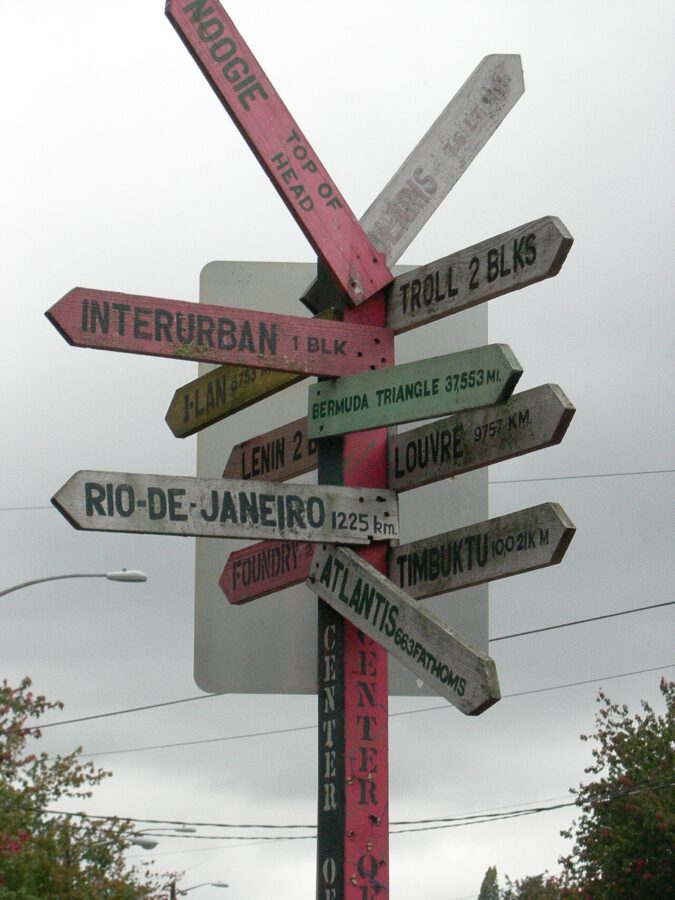
A block east, on the traffic island where Fremont Avenue North meets North 35th Street, a painted guidepost points the way to the troll, the Interurban and places as far off as Rio de Janeiro. It’s the neighborhood’s claim to be the center of everything, in arrow form.
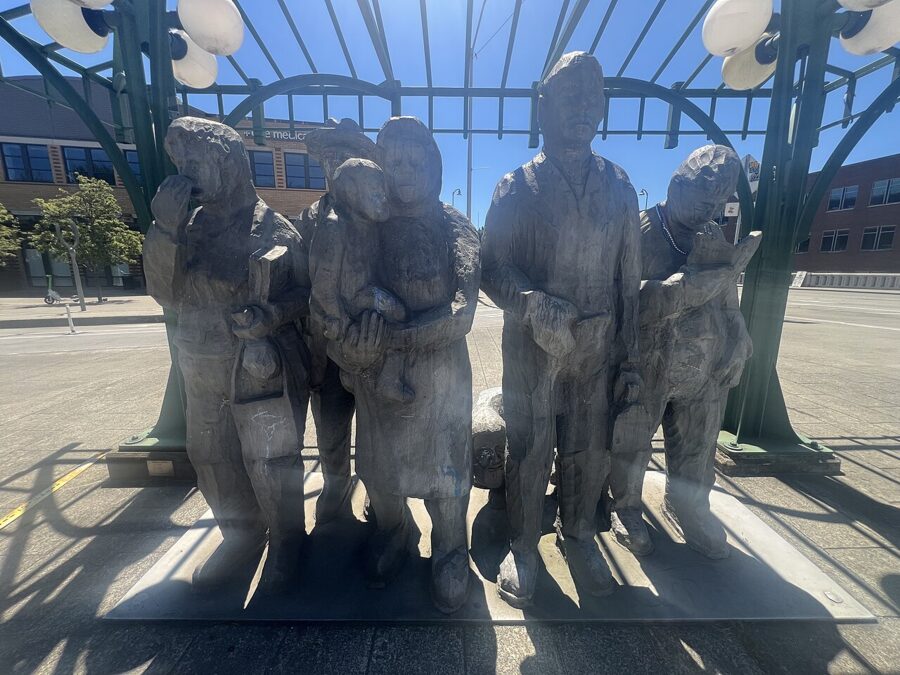
At the corner of North 34th Street and Fremont Avenue North, Richard Beyer’s 1979 sculpture Waiting for the Interurban, a group of cast figures, stands at what has been a transit stop since the streetcar days. Locals dress them in costumes, signs and scarves for birthdays and causes, so they rarely look the same twice.
Fremont Sunday Market
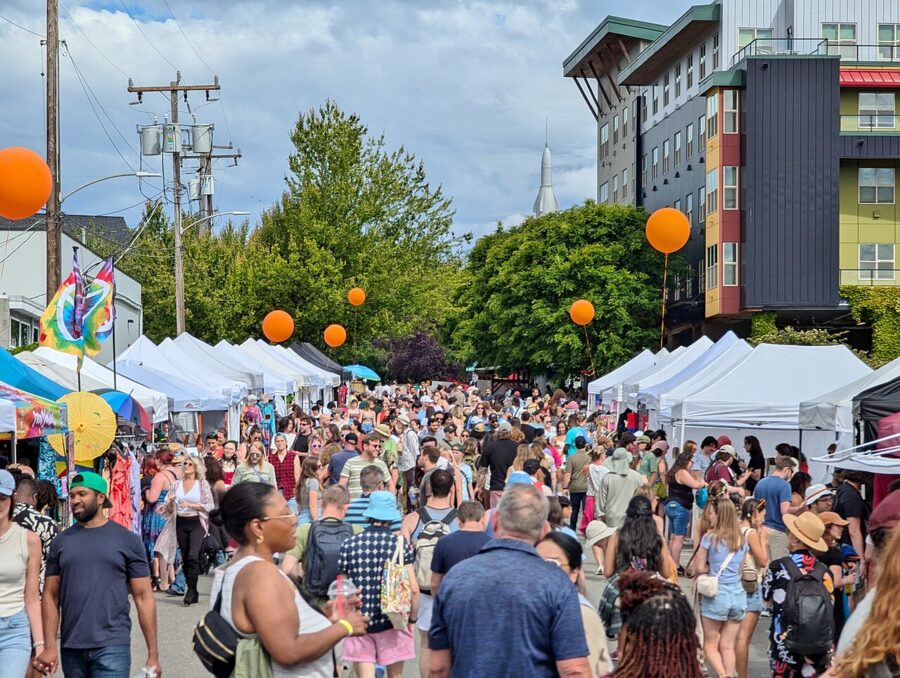
The Fremont Sunday Market runs every Sunday from 10 a.m. to 4 p.m., year-round and rain or shine, and closes only the weekend of the Fremont Fair. From late March it fills two blocks of North 34th Street along the canal with more than 200 booths of vintage, antiques, crafts and food trucks. In winter it moves under cover beneath the Fremont Bridge.
Come at opening if you want the stalls without the crowd, and keep the troll for afterward, since Sunday midday is also when its line is longest.
Solstice, the fair and Trolloween
Fremont’s big weekend is the Fremont Fair in June, around the summer solstice, with the Solstice Parade organized by the Arts Council. Its costumes, painted cyclists and homemade floats make it the brightest day of the neighborhood’s year for photographers. Trolloween on October 31 is the darker, smaller counterpart.
The canal, the trail and the Fremont Bridge
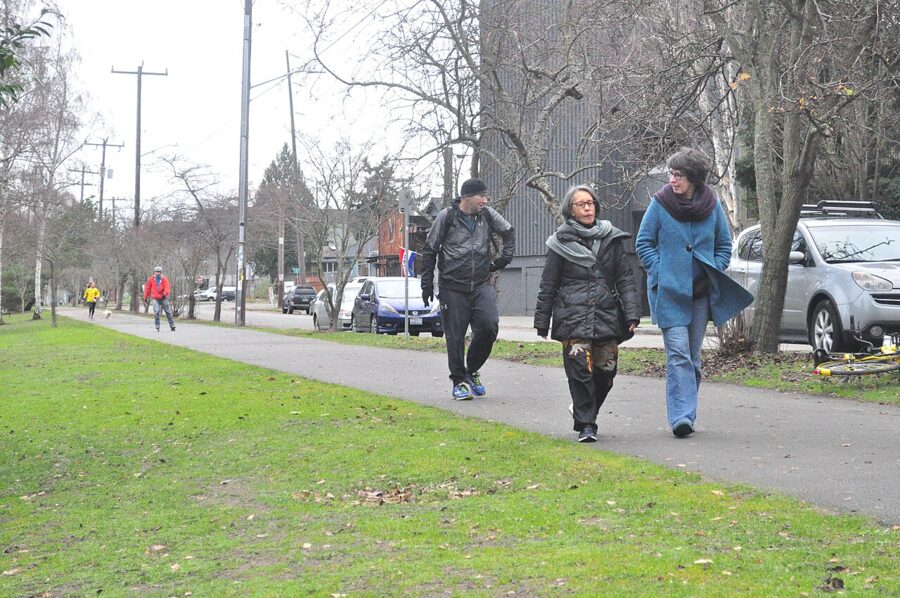
At the foot of the neighborhood, the Burke-Gilman Trail runs along the north bank of the Fremont Cut, the narrow stretch of the Lake Washington Ship Canal. Walk it east from the Fremont Bridge and you pass under the Aurora Bridge and reach Gas Works Park in about a mile.
The blue Fremont Bridge is a low drawbridge that opened in 1917, and it lifts often for boats. When the traffic gates come down, get to the canal bank: a raised span with a sailboat passing under it is a better picture than the bridge at rest.
Gas Works Park
About a mile east of the troll along the trail, Gas Works Park keeps the towers of the Seattle Gas Light Company’s old plant, which made gas from coal and later oil from 1906 to 1956. The designer Richard Haag turned it into a park that opened in the 1970s, and its grassy mound, Kite Hill, is one of the city’s favorite places to watch the sun go down. The park at 2101 North Northlake Way is open 6 a.m. to 10 p.m., and there is no charge.
The towers themselves are fenced; signs ask you not to climb them, so photograph from the lawn. Seattle Parks prohibits entering Lake Union from the park, with no swimming, wading or fishing, because the lake bed holds contaminated sediment. The city lists a sediment cleanup project for 2026 to 2030, so check the Seattle Parks page for work areas before you go.
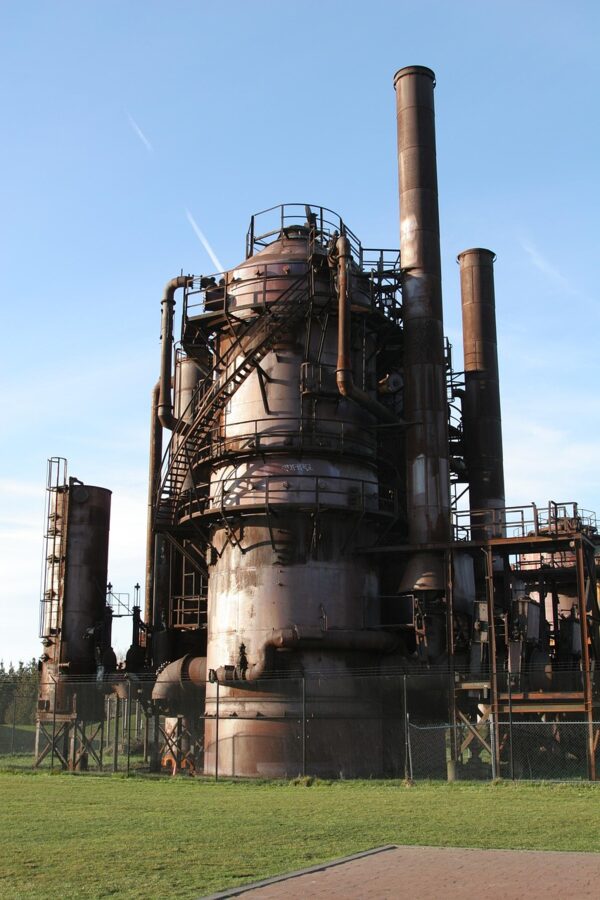
Gas Works is also a skyline viewpoint, with downtown across the water to the south. For the skyline itself, Kerry Park on Queen Anne Hill is the classic spot; on this walk, the view worth stopping for at Gas Works is the Aurora Bridge end-on from the top of the hill.
The other trolls around Puget Sound
Search for trolls near Seattle and you will also find the Northwest Trolls, six giant wooden figures built in 2023 by the Danish artist Thomas Dambo from recycled timber. Five are in Washington: Frankie Feetsplinter outside the National Nordic Museum in Ballard, and others in Lincoln Park in West Seattle, on the Rainier Trail in Issaquah, at Sakai Park on Bainbridge Island and at Point Robinson Park on Vashon Island. The sixth, Ole Bolle, is at Nordic Northwest in Portland, Oregon.
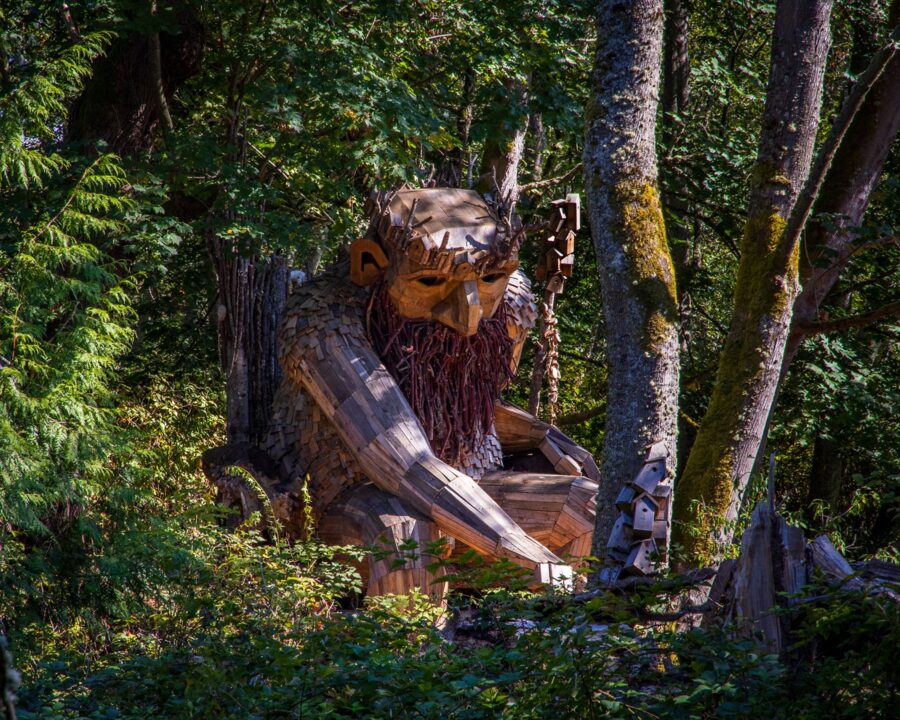
Frankie in Ballard is the easy pairing with Fremont, a short ride west along the canal; the others are half-day trips.
Planning the visit
| Stop | Where | When | Cost |
|---|---|---|---|
| Fremont Troll | N 36th St and Troll Ave N | Any time; quietest early on weekdays | Free |
| Lenin statue | Fremont Pl N at N 36th St and Evanston Ave N | Any time | Free |
| Fremont Rocket | N 35th St and Evanston Ave N | Any time | Free |
| Fremont Sunday Market | 3401 Evanston Ave N | Sundays 10 a.m.–4 p.m., year-round | Free entry |
| Gas Works Park | 2101 N Northlake Way | 6 a.m.–10 p.m. | Free |
On a weekday, come to the troll first thing, walk down through the rocket and the guidepost to the canal, and follow the trail east to Gas Works for the Aurora Bridge against the evening sky. On a Sunday, do the market at ten and leave the troll until the afternoon crowd thins. Either way, the troll is the one stop where the weather barely matters: under that deck it is always the same soft gray light.