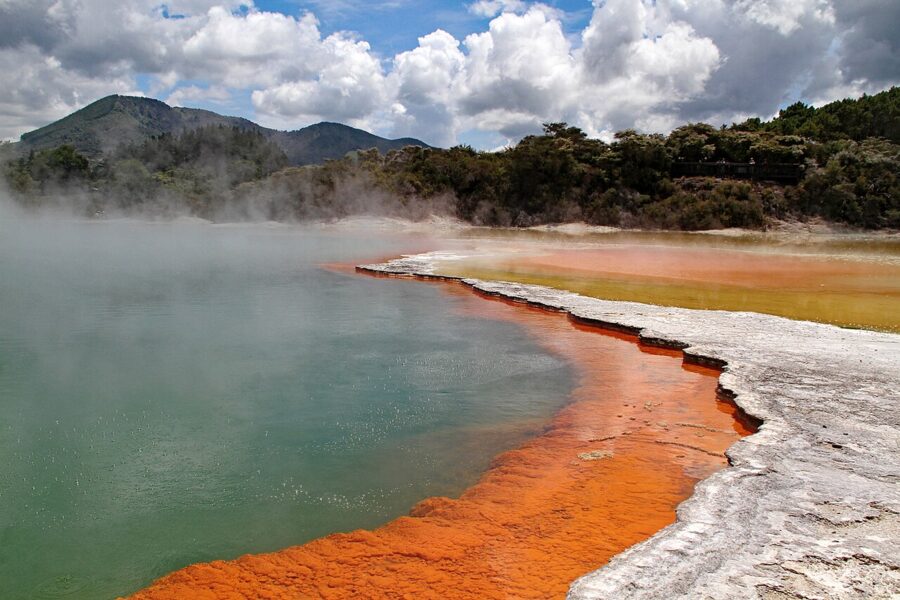
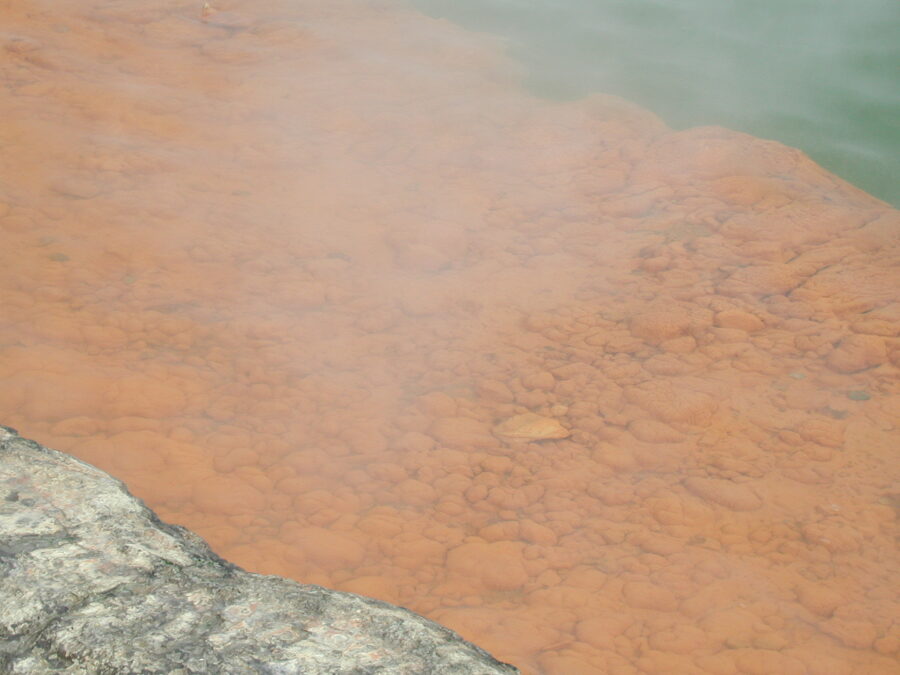
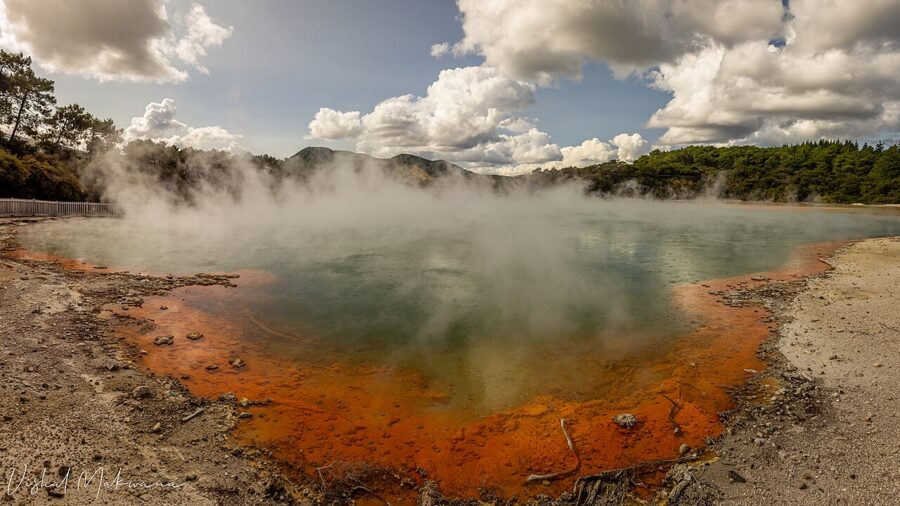
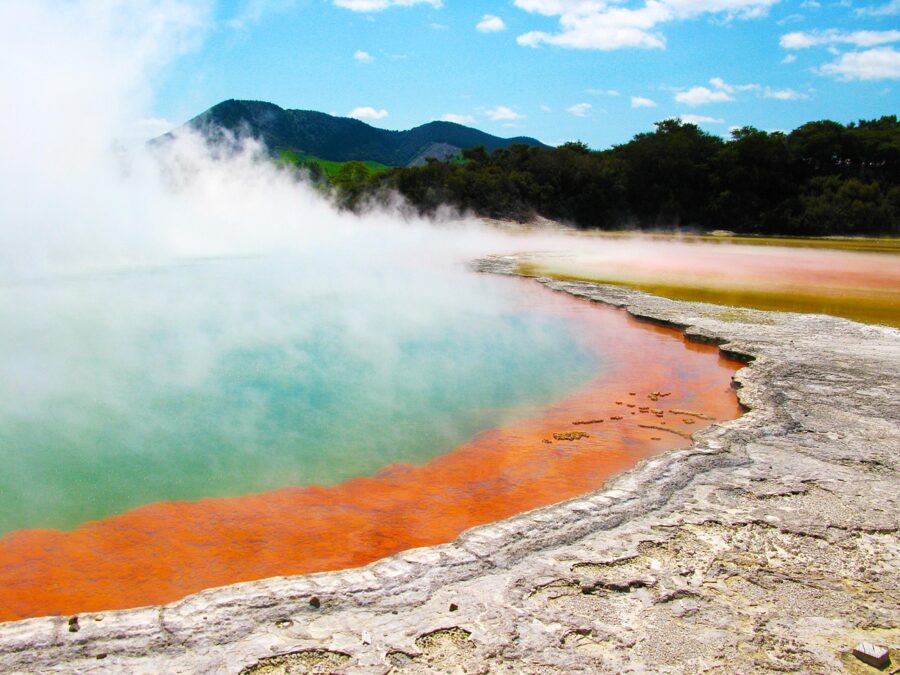
The Champagne Pool is 65 meters across, 62 meters deep and about 74°C at the surface, and the orange band around its rim is arsenic and antimony sulfide settling out of the water as it cools. It sits halfway round the first loop at Wai-O-Tapu Thermal Wonderland, 31 km south of Rotorua. On most days you see its steam before you see the pool.
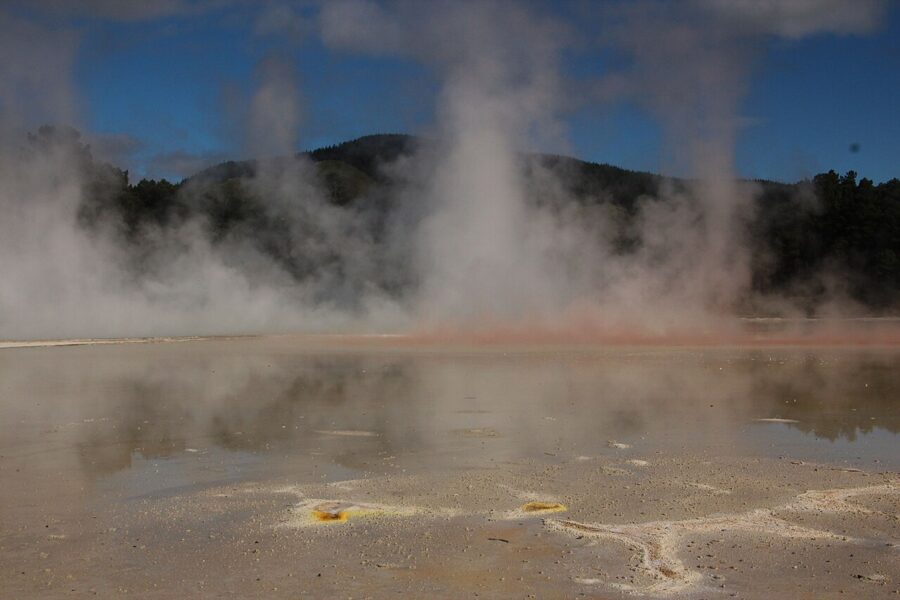
That steam decides almost every picture you take here. On a cold, still morning the pool can vanish behind a white wall; on a warm, breezy afternoon it lifts away and the colors come through. The park opens at 8:30am and takes its last visitors at 3pm, so sunrise and sunset are off the table, and your choices come down to season, hour and wind.
The same ticket covers two longer walks, down over the Primrose Terrace and out to Lake Ngakoro, and the morning eruption of Lady Knox Geyser, a two-minute drive away. The Mud Pool on the same road is free.
Contents6 parts
What colors the Champagne Pool
The pool fills a crater blown out by a hydrothermal eruption, a violent release of steam and hot water rather than magma. A 2020 study in the Bulletin of Volcanology dates it to about 700 years ago and reads the debris as two phases: a narrow jet that threw up rock from at least 110 meters down, then a larger, shallower blast once the jet broke through a hard, silica-cemented cap. The park’s walk sheet now gives 700 years as well, though older material says 900, and you will meet both figures on the signs and in print.
Carbon dioxide rising through the water gives the fizz and the name. The park’s walk sheet lists gold, silver, mercury, sulfur, arsenic, thallium and antimony among the minerals in the water. Where it meets the cooler rim, arsenic and antimony sulfides drop out of solution, and researchers studying the rim have found that they form on colonies of heat-loving microbes rather than on bare rock.
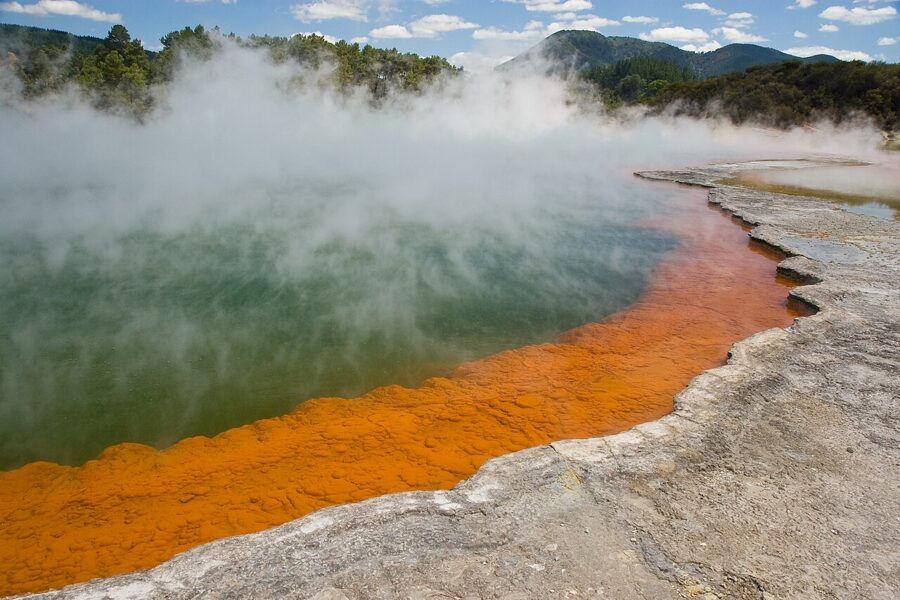
The green-blue of the water comes from very fine silica held in suspension, the same material that builds the grey shelf. The pool’s overflow spreads across the Artist’s Palette and then down over the Primrose Terrace, leaving minerals behind as it evaporates. The operator’s own description of the Palette is that it never looks the same two days running, because sun, water level and wind all change it.
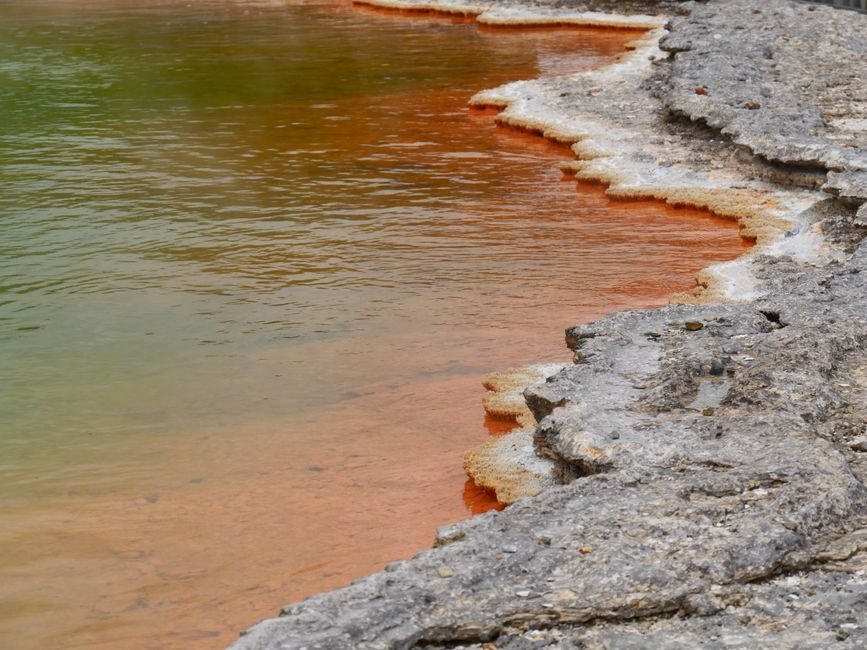
Nobody swims in it, and the track keeps you well back from the water. The surface water would scald, the operator warns that thermal pools can carry toxic gases at the surface, and the crust around a pool can look solid and give way. Staying on the formed paths and behind the barriers is a condition of entry, not a suggestion.
The three walks, and what is on each
Wai-O-Tapu is self-guided on three connected loops. Walk 1 is 1.5 km and about 45 minutes, Walks 1 and 2 together are 2 km and an hour, and all three are 3 km and about 90 minutes, according to the walk sheet issued with the ticket. The paths are gravel and boardwalk, and the operator says strollers manage Walk 1 only.
Allow two and a half to three hours for all three walks plus the geyser and the Mud Pool. Last admission is 3pm and you must be back at the visitor centre by 4:15pm, so a 2:45pm start buys you Walk 1 and little else.
Walk 1: Craters, the Artist’s Palette and the Pool
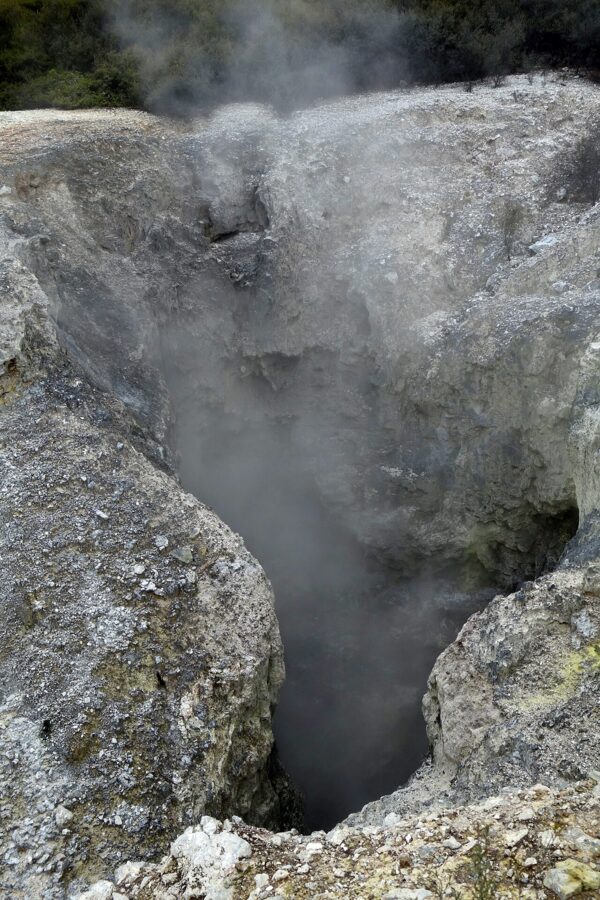
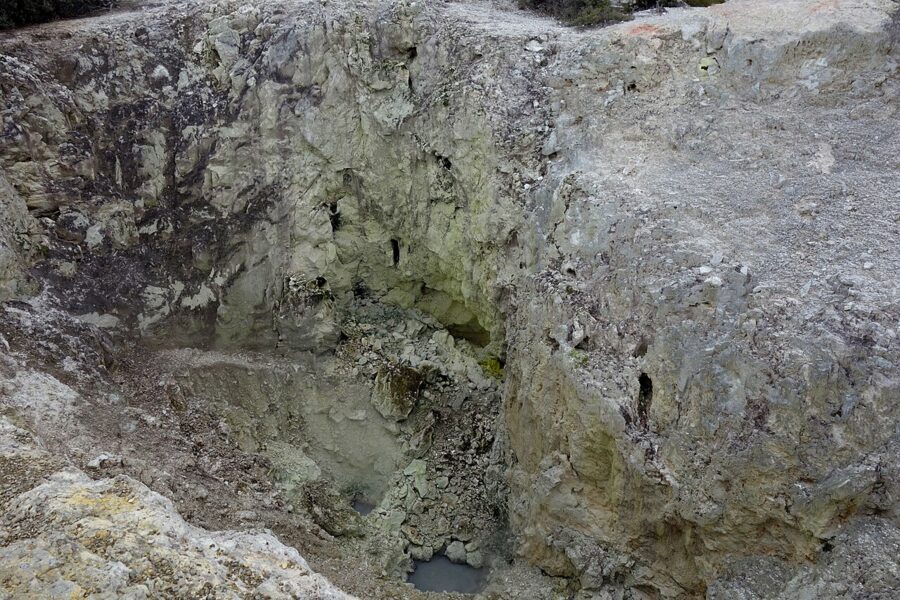
The first loop opens among collapsed craters, where acidic steam has eaten the ground away from below. Te Rua Uenuku, the Rainbow Crater, shows the mineral key in its walls: iron oxide for red and brown, manganese for purple, sulfur for yellow and kaolin for white. Te Rua Whaitiri, the Thunder Crater, collapsed in 1968 with a noise like thunder and is now four times its original size.
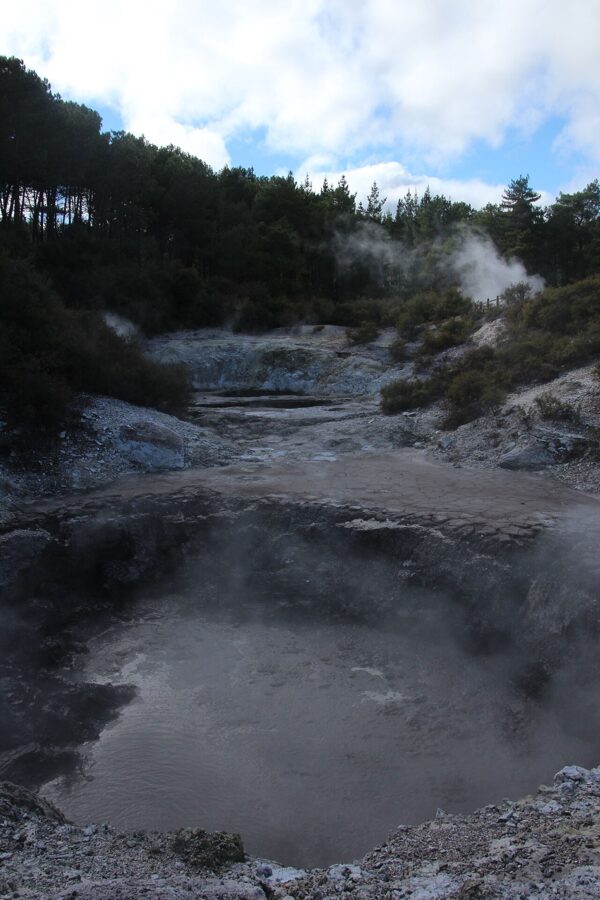
From the craters the track crosses the Artist’s Palette on a boardwalk and follows the Champagne Pool around its southern and western rims. On the way back toward the exit you pass Rua Pūmahu, a crater with boiling mud in its floor, and Rua Ōwhanga, where birds nest in the warm walls. The loop ends at Roto Kārikitea, the Devil’s Bath.
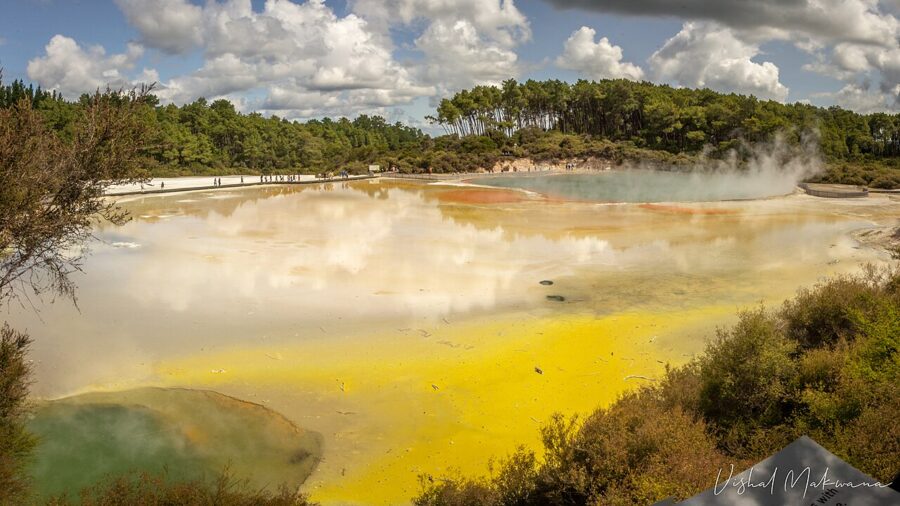
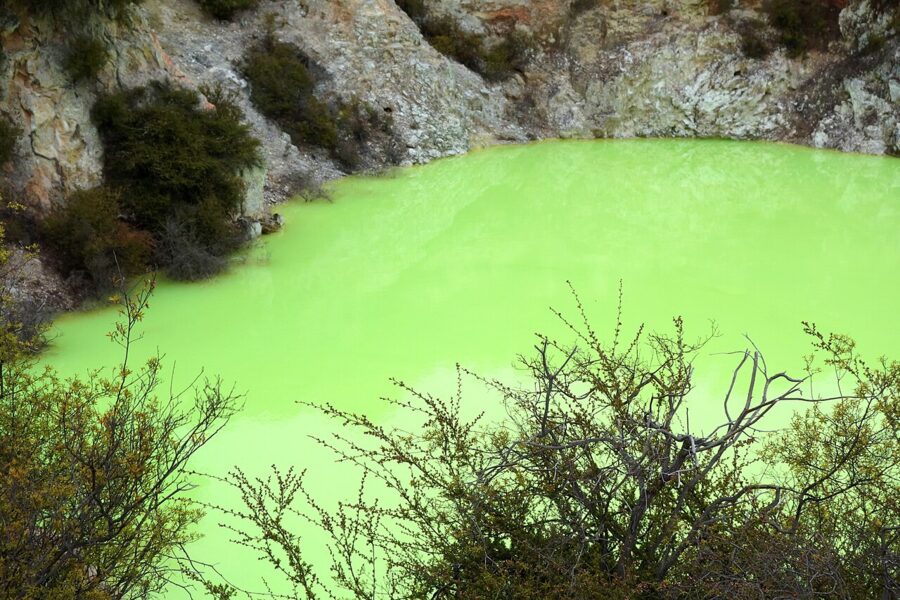
The Devil’s Bath is the shot most people take after the Champagne Pool: an acid lime-green, pH 2 and only 14°C, filled by the pool’s excess water. The color comes from minerals suspended in the water, and the walk sheet says plainly that it is brighter on sunny days and duller under cloud. If the sky is grey when you reach it, expect a flatter green.
Walk 2: Along the Primrose Terrace
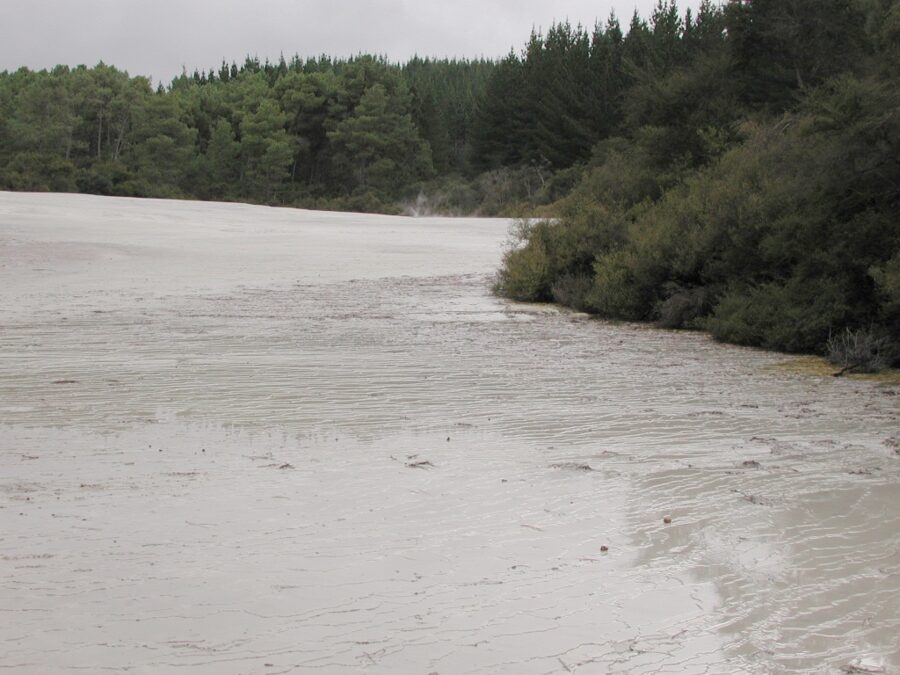
Walk 2 adds about 15 minutes and 500 meters, dropping from the Champagne Pool to the Primrose Terrace. The walk sheet calls these the largest sinter terraces in New Zealand: about 1.5 hectares of silica laid down by the pool’s overflow over 700 years, and still growing upward and outward. From Te Wairiki o Mahuika, a sulfurous spring at the terrace edge, the side view runs down the valley to the Ohaaki geothermal power station.
Near the pool the track passes Te Waiāriki o Aporo, a bath filled by Champagne Pool runoff. It takes its name from Chief Aporo, who guided visitors here as early as the late 1800s and liked a soak in it.
Walk 3: Frying Pan Flat and Lake Ngakoro
The longest loop heads down the valley below the terraces. Papa Wera, the Frying Pan Flat, is an eruption crater whose unstable floor is pocked with bubbling springs and gas vents, and pied stilts (poaka) pick insects off it. Nearby, Te Puna Tio, the Oyster Pool, is seen from a timber boardwalk, and Rua Whānariki, the Sulphur Cave, holds yellow crystals that grow where the gas cools under an overhang.
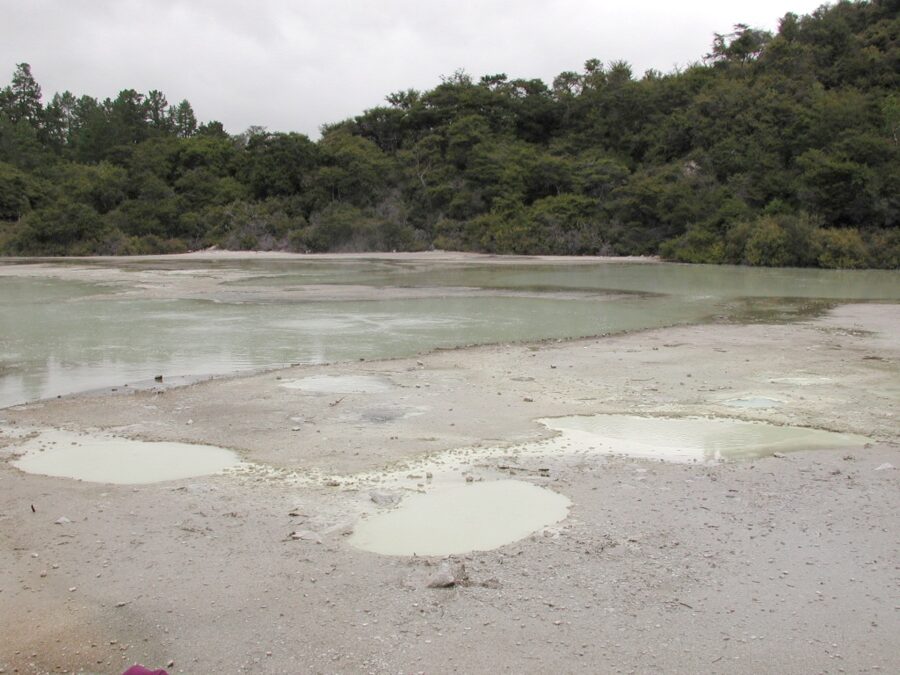
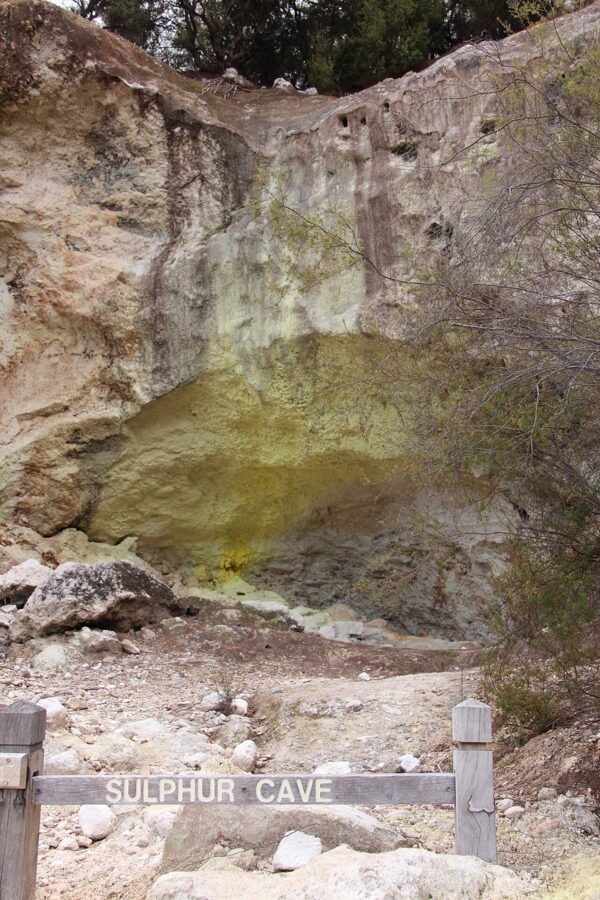
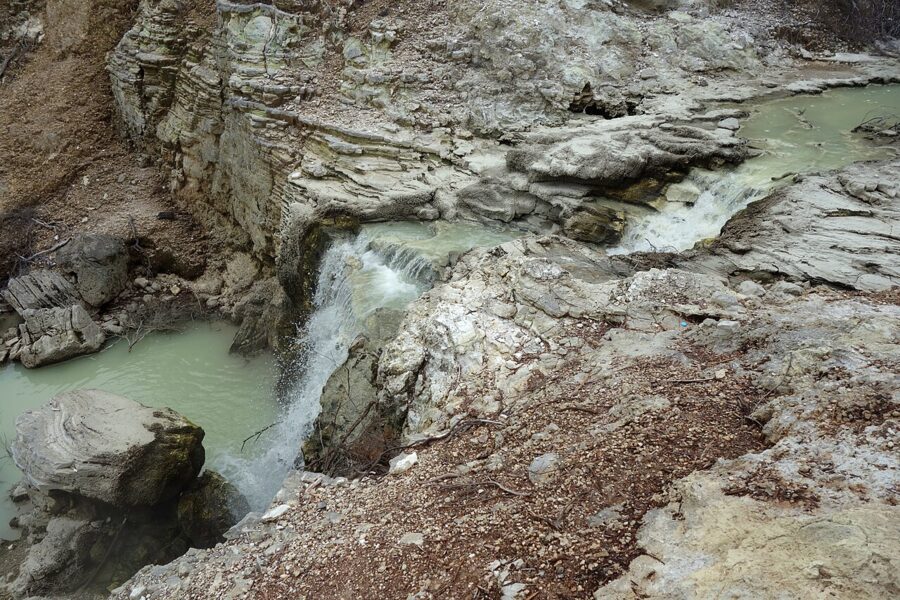
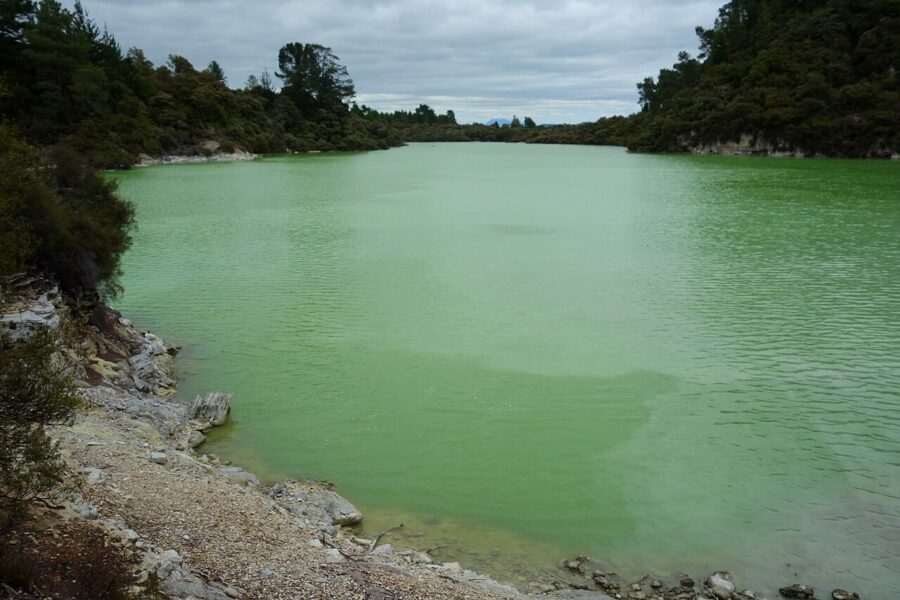
At the bottom, a warm waterfall spills into Lake Ngakoro, a crater lake kept green by algae in water that stays warm all year. The return climbs through tall kānuka on the Native Bush Walk, where you may hear bellbirds and tūī and see fantails (pīwakawaka). From the Panoramic View below the terraces, a clear day shows the Kaingaroa Forest and, far to the south, Mount Ruapehu.
Lady Knox Geyser at 10:15, and the free Mud Pool
Lady Knox Geyser erupts once a day, at 10:15am, because staff set it off. Soap poured into the vent breaks the surface tension on the hot water, and the column rises 10 to 20 meters. Prisoners from a camp nearby found the effect while washing clothes in the spring, and the geyser is named for Lady Constance Knox, a daughter of the governor of the day.
The geyser arena is a two-minute drive from the visitor centre, and you must drive it. The operator asks you to arrive by 9:45am, and there are no toilets at the geyser. Your park ticket covers the presentation, and the booking notes describe going to the geyser first and then driving on to the park.
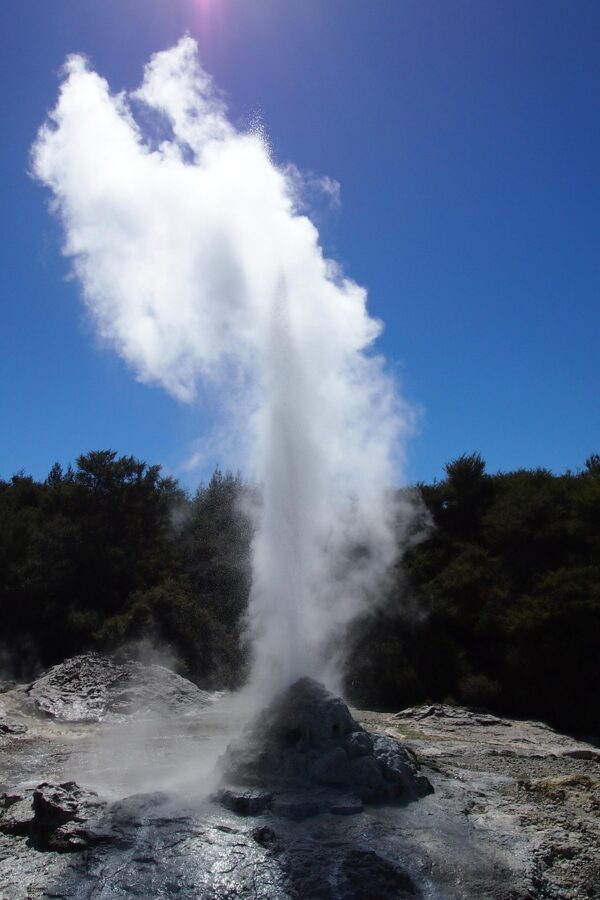
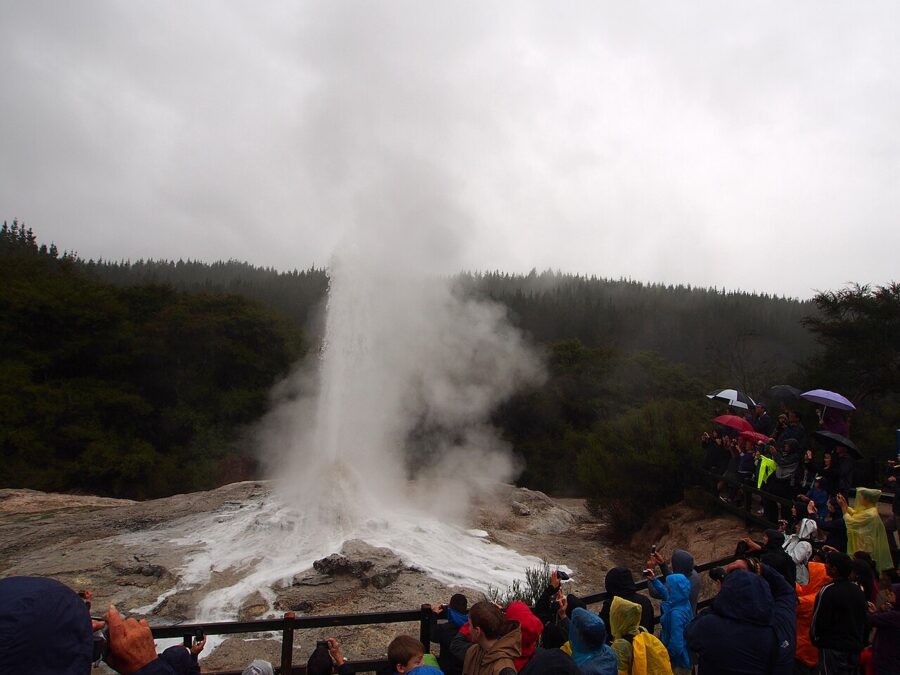
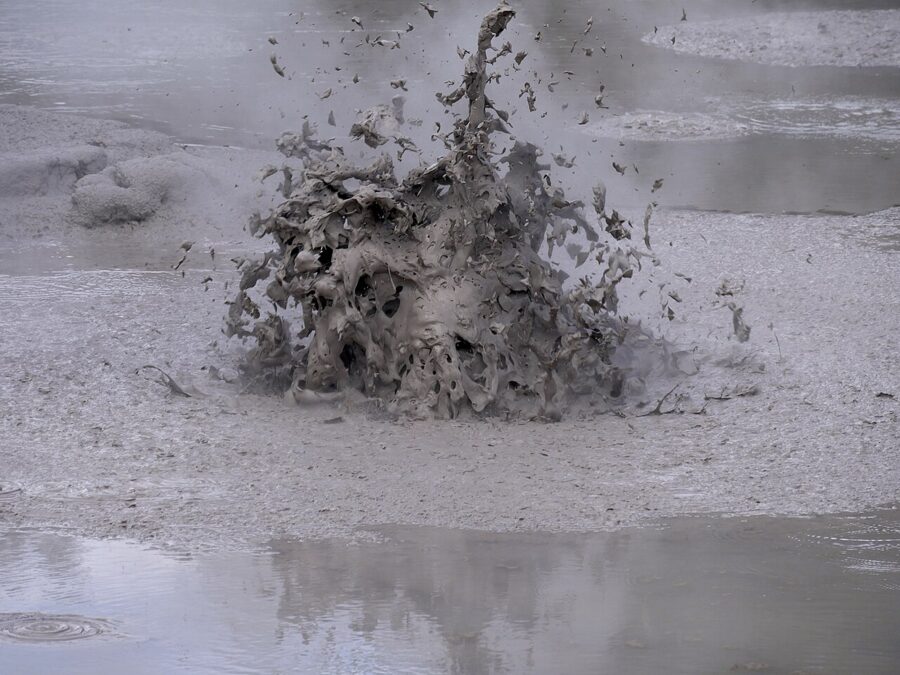
The Mud Pool sits on Waiotapu Loop Road about 1.5 km north of the visitor centre, on a Department of Conservation boardwalk outside the ticketed park, and DOC lists no fee. It is the largest mud pool in New Zealand and was once a mud volcano whose cone survived until 1925 and has since eroded away. In 2018 a burst of steam and mud erupted beside the pool, which a GNS Science volcanologist described as uncommon but not unexpected.
Photographing the Champagne Pool
Where to Stand
The track wraps the pool’s southern and western rims, so you look north and east across the water, with the Artist’s Palette beyond the far side. The boardwalk across the Palette gives the long view, with the flats in front and the pool’s steam rising behind. The lookout above the Palette’s north side is higher and takes in more of both, at the cost of any rim detail.
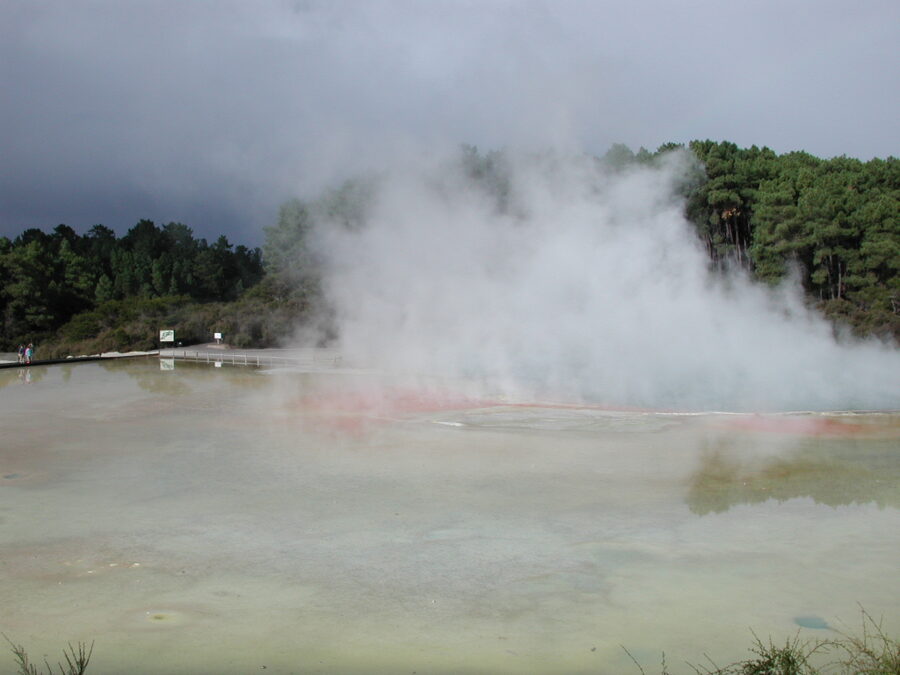
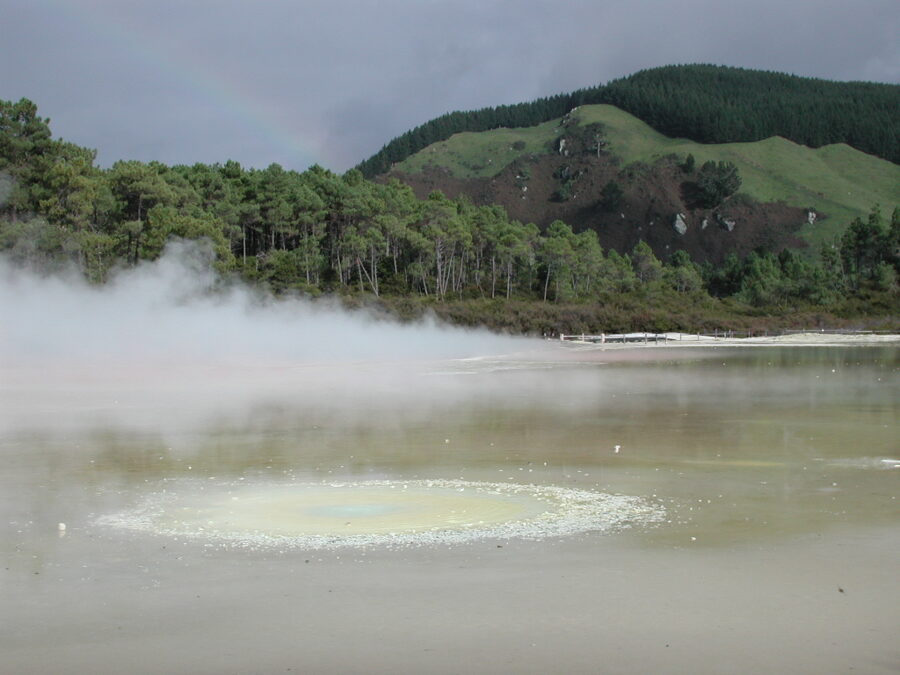
On the rim itself, walk the whole curve before you settle, because the best stretch is wherever the wind is pushing the steam away from you. A westerly clears the near water along the western rim; a southerly does the same for the southern side. Choose your spot, then wait for the gaps.
Crowds follow the geyser. Most people drive up from the 10:15 presentation at once, so I would expect the rim to be at its busiest from late morning, and I would plan around that: Walk 1 at 8:30am before the geyser, or the pool in the afternoon after the morning shuttle from Rotorua has headed back.
Steam and Light by Season and Hour
Steam is condensation, so how much you get depends on the gap between the water and the air. With the surface near 74°C all year, a winter morning can bury the pool completely, while a warm January afternoon may leave only wisps. Spring and autumn give the mix most photographers want: enough steam for mood, enough breeze to open the view.
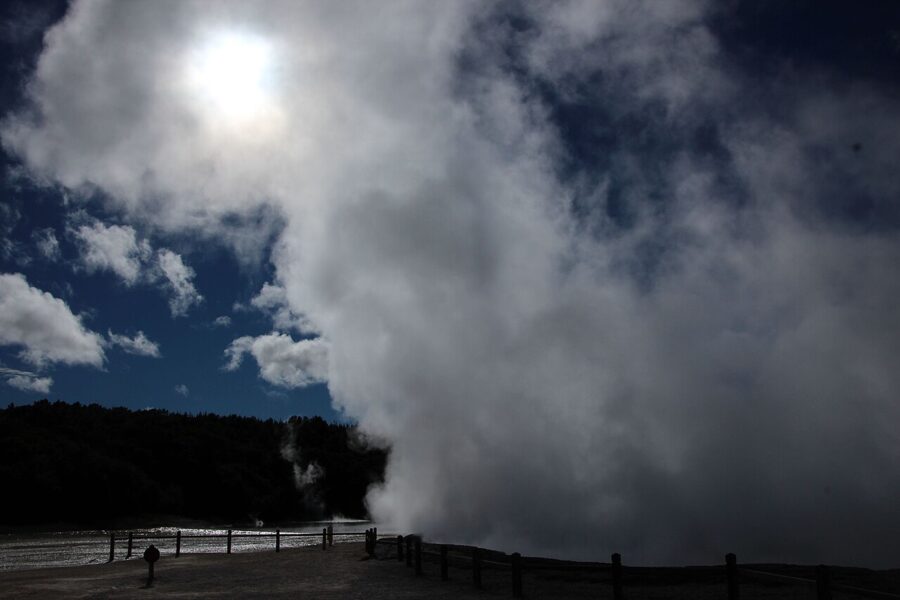
The sun sits in the northern sky here. At solar noon it stands about 75 degrees high in late December and only about 28 degrees in late June, and with daylight saving that noon falls near 1:15pm in summer and near 12:15pm in winter. Summer light comes from high overhead through the middle of the day, which suits the colors; winter light crosses the water low and catches the steam from the side even at noon.
If color is the priority, aim for early afternoon between November and March with a breeze. If you want the steam, come on a cold, still morning between May and September and face east from the western rim, toward the low sun. Either way, check a sun calculator and the wind forecast for the date before you pick the day.
The Polariser and the Rest of the Kit
A circular polariser earns its place here. Turned to cut the glare off the surface, it deepens the green and shows the orange shelf where it runs under the water. Turn it off for backlit steam, which it dulls, and watch wide frames of sky, where it darkens one side more than the other.
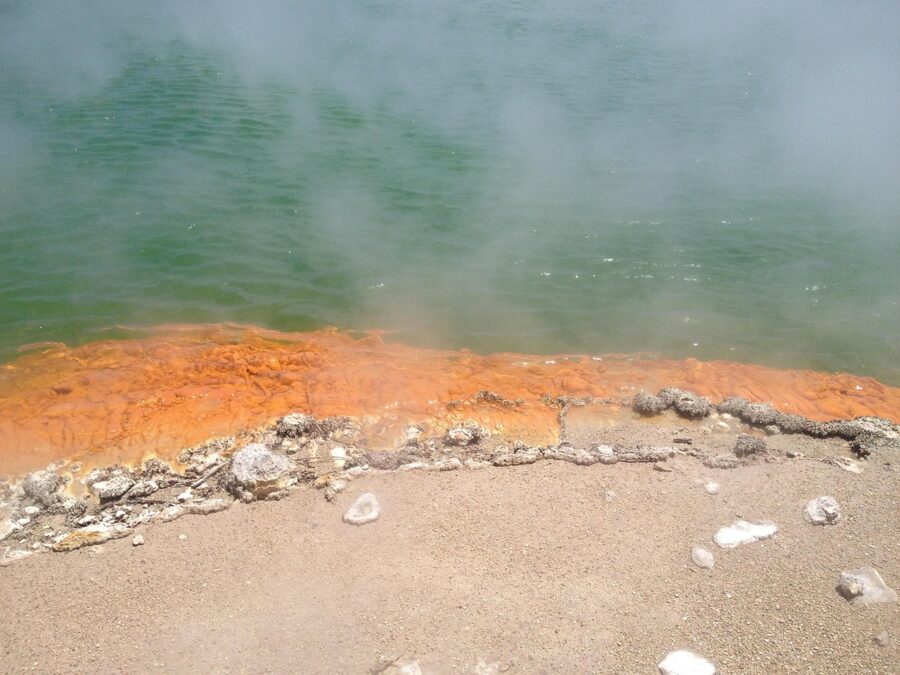
A wide lens, around 16 to 24 mm on full frame, takes in the curve of the rim from the track, and a short telephoto picks out the bubbles and the shelf. Carry a lens cloth, because steam condenses on the front element the moment it drifts over you. If you have photographed the hot springs of Yellowstone, the method carries over: polariser for the water, wind at your back for the steam. Drones are not permitted anywhere in the park, and the operator points to the helicopters and light aircraft that fly through the area.
Tickets, hours and getting there
As of November 2026:
| Hours | 8:30am to 4:30pm daily, last admission 3pm, back at the visitor centre by 4:15pm; closed Christmas Day |
|---|---|
| Adult (16 and over) | NZ$49 (about US$27) |
| Child (15 and under) | NZ$18 (about US$10) |
| Lady Knox Geyser | 10:15am daily, arrive by 9:45am; included in the park ticket |
| Payment | Cashless: major cards and EFTPOS only |
| Mud Pool | Department of Conservation boardwalk on Waiotapu Loop Road; free |
Tickets sell online and at the visitor centre, which has the café, a shop, a picnic area and the only toilets. There are none in the park itself or at the geyser. The whole attraction is smoke-free, and the operator says jandals, sandals and heels are not suitable on the uneven ground.
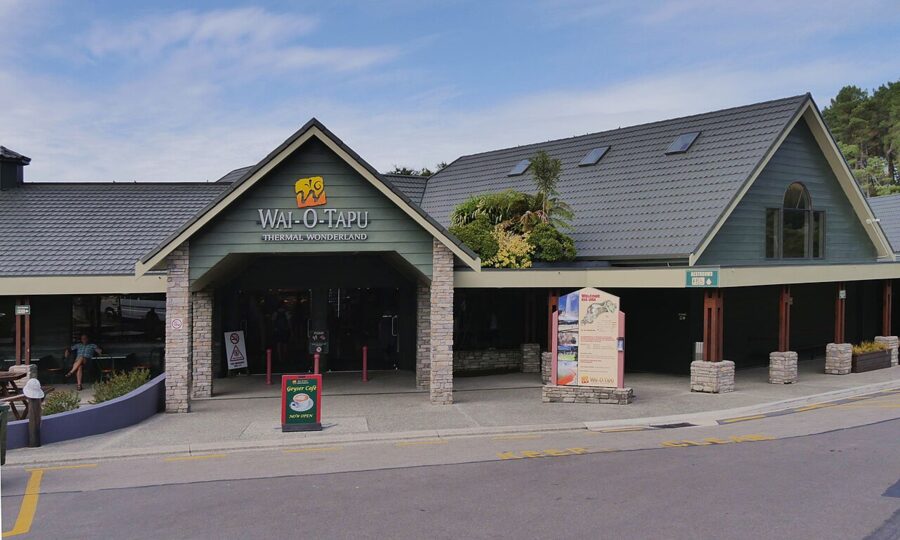
From Rotorua, drive south on State Highway 5, the Thermal Explorer Highway, for 27 km (about 20 minutes), turn left onto Waiotapu Loop Road and go 2 km; the operator puts the full trip at 31 km and 27 minutes. From Taupō, drive north on SH5 for 53 km (about 40 minutes), turn right where signposted and go 1 km. The operator advises extra travel time in summer.
Without a car, Rotorua’s i-SITE sells a shuttle and entry package for NZ$119 (about US$66) as of November 2026, leaving the i-SITE at 1167 Fenton Street at 9am and returning by 1:30pm, daily except Christmas Day and New Year’s Day. It is timed for the geyser, so you will share the pool with everyone from the presentation. From Auckland the drive is 257 km and about 3 hours 20 minutes, which makes the geyser a very early start.
Other geothermal parks nearby
Several more geothermal parks sit along the roads between Rotorua and Taupō, and each does one thing better than Wai-O-Tapu. None of them has a pool like the Champagne Pool.
Te Puia, in the Whakarewarewa valley on Rotorua’s southern side, has Pōhutu, New Zealand’s largest geyser, which erupts on its own to 15 to 20 meters and sometimes higher, up to about 20 times a day. Te Puia is also home to the New Zealand Māori Arts and Crafts Institute and a kiwi conservation centre, and visits there are guided. Go there for culture and a natural geyser, and to Wai-O-Tapu for color.
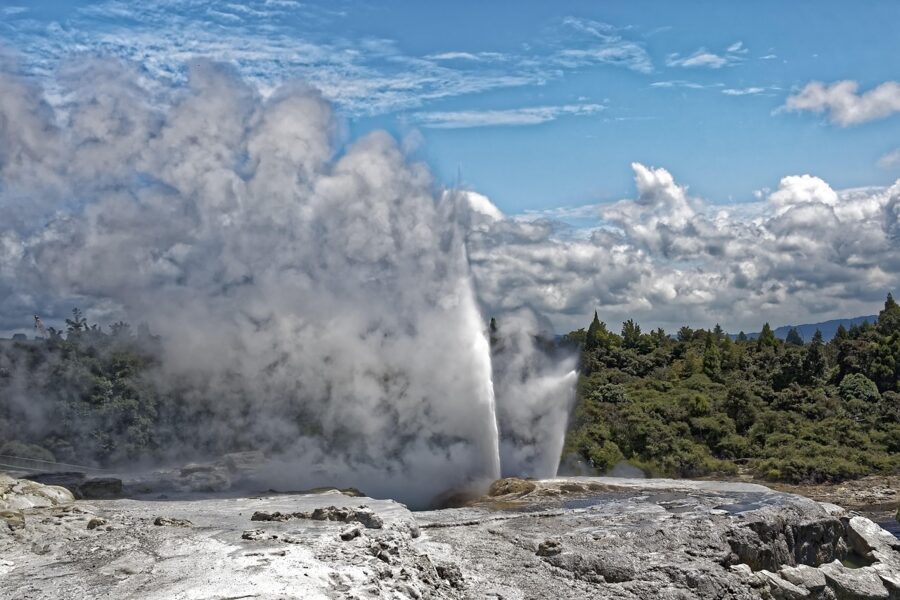
Waimangu Volcanic Valley, reached off SH5 between Rotorua and Wai-O-Tapu, dates only from the eruption of Mount Tarawera on 10 June 1886. Its Frying Pan Lake, formed in a further eruption in 1917, is the largest hot spring in the world by surface area, by the operator’s count. The walk runs down the valley to a 45-minute boat cruise on Lake Rotomahana, and Te Puia has managed Waimangu day to day since December 2025.
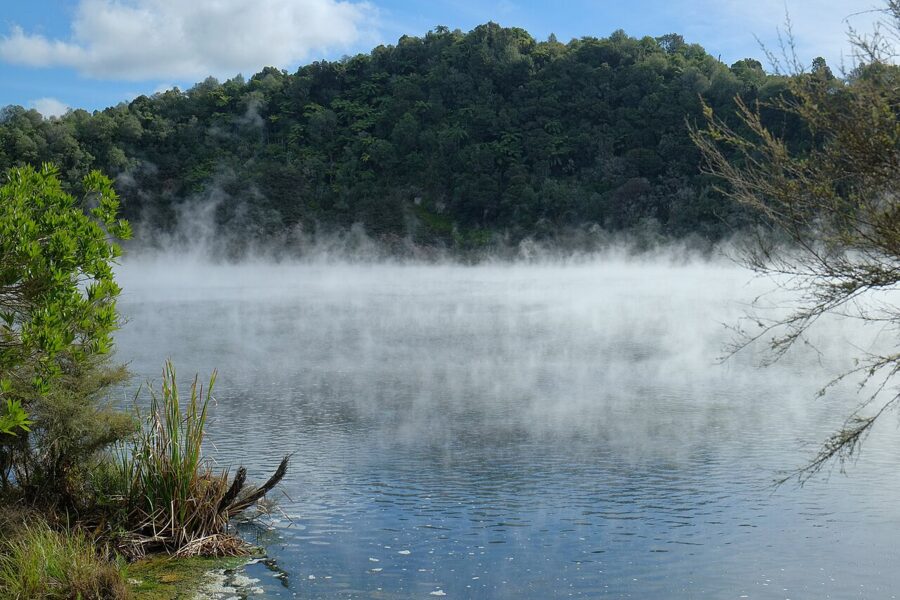
Orakei Korako, 25 minutes from Taupō and 45 from Rotorua, begins with a short boat crossing of Lake Ohakuri on the Waikato River. Its operator counts up to 23 active geysers and some of the largest silica terraces in the world, and the ferry runs on demand from 8am with the last trips at 4pm. For terraces and natural geysers together it beats Wai-O-Tapu; for one great pool it does not.
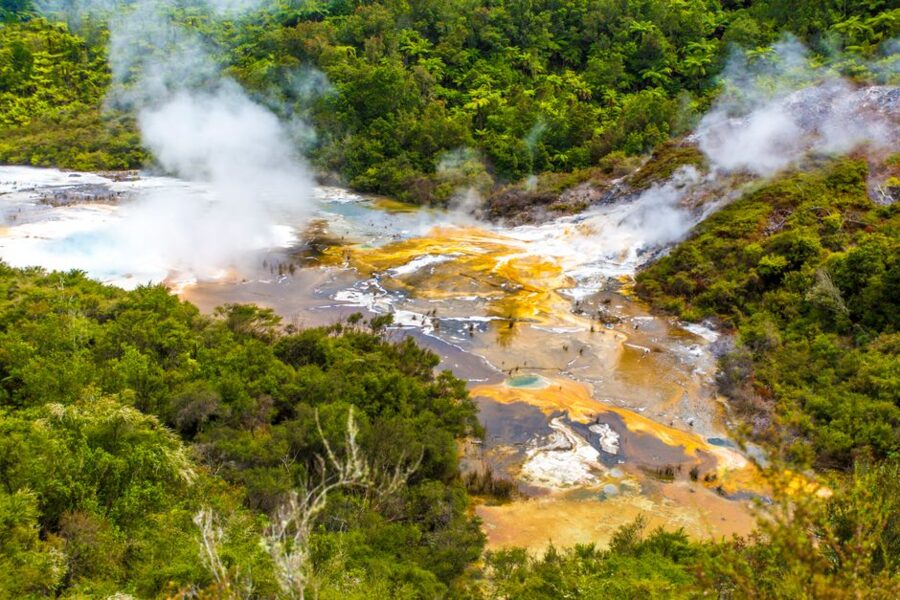
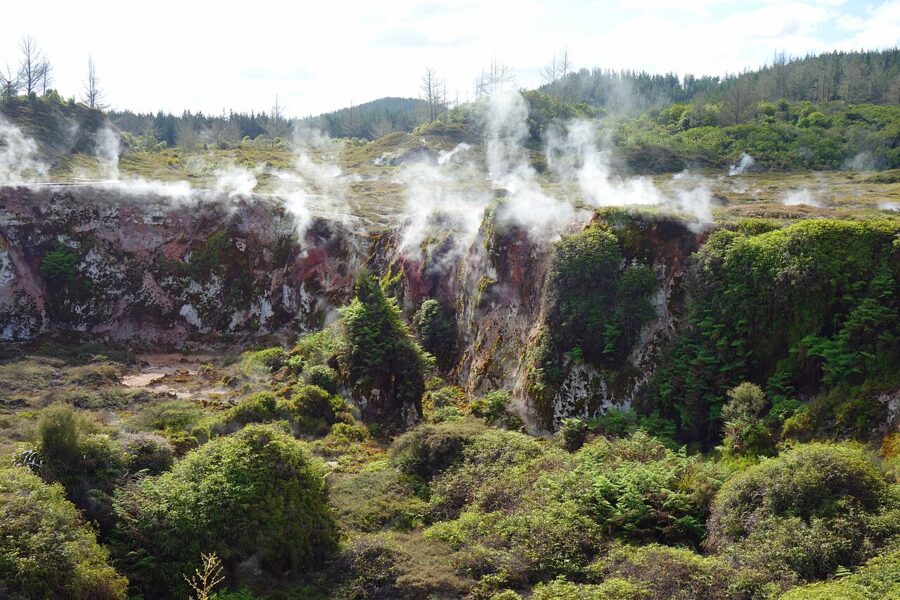
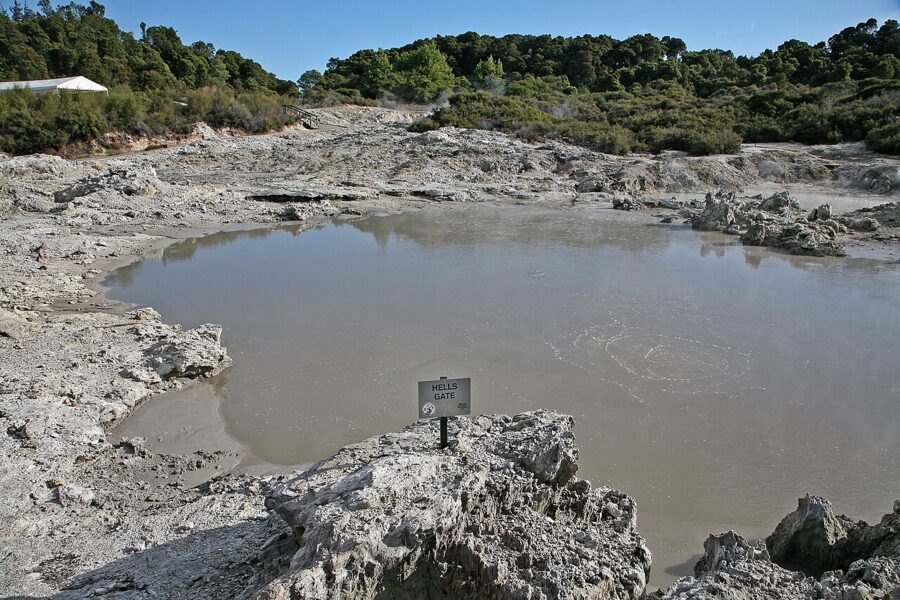
Craters of the Moon, just north of Taupō, is a 40-minute loop of steaming craters and fumaroles, with 20 more minutes to a lookout. It is open every day except Christmas Day, and its operator says plainly that in summer you will see steam and craters but rarely mud. Hell’s Gate (Tikitere), on the far side of Rotorua, pairs a geothermal walk past a mud volcano and a hot waterfall with mud baths and a sulfur spa; go there to get into the mud rather than to photograph it.
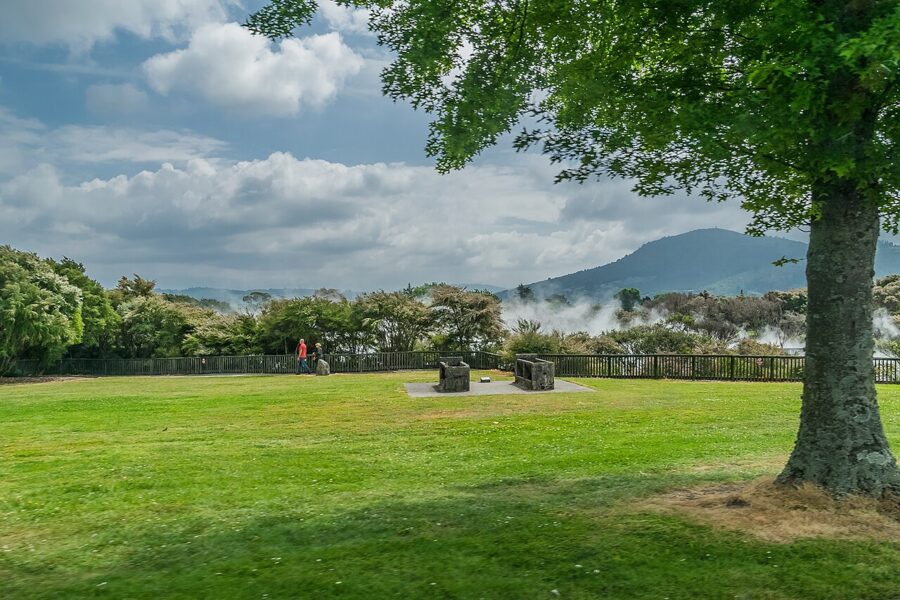
Kuirau Park in central Rotorua is a public park with steaming pools and mud behind fences and no ticket at all. Half an hour there will tell you whether you like the sulfur smell enough for a full day at Wai-O-Tapu.
If you have one visit, make it an early afternoon between November and March with a westerly blowing, and walk straight to the western rim. If you have two, add a cold autumn morning for the steam.